


Last Updated: April 2026 (Updated to reflect current Canadian auto refinancing trends and lender requirements.)
Published: October 2023
By: Danielle Burton
Category: Auto Refinancing, Negative Equity, Trade-In
Refinancing your auto loan in Canada is an effective way to take control of your financial obligations, especially if you are dealing with high interest rates or challenges with your credit situation. If you are wondering how to refinance a car loan in Canada, the process can be straightforward and tailored to your financial needs. By improving your credit score or adjusting your loan terms through auto refinancing, you can reduce your monthly car payments and create a more manageable financial structure.
Whether you are working with traditional banks or exploring options through online lenders, there are flexible financing options available for a wide range of borrowers. This includes those managing negative or positive equity, navigating vehicle depreciation, or simply looking to lower their ongoing car payments.
The auto refinance process is designed to help you replace your existing loan with one that better aligns with your current credit history and financial goals. This typically involves completing a refinance application, reviewing lender requirements, and comparing offers to secure better interest rates. With consistent payments, refinancing can also help strengthen your credit profile over time.
In this guide, you will learn how the refinancing process works, when it makes sense to refinance, and how to evaluate your options effectively. From understanding the impact on your credit score to comparing online lenders and traditional banks, this article will help you make informed decisions and improve your financial position with SafeLend Canada. With platforms like SafeLend Canada, comparing multiple lenders and offers can be done quickly and entirely online, without the need to go through a dealership or trade-in process.
In This Guide:
- 1. What is Car Loan Refinance in Canada?
- 2. What are Your Auto Loan Refinancing Options in Canada?
- 3. What Are the Pros and Cons of Refinancing a Car Loan in Canada?
- 4. Can Refinancing a Car Loan Lower Your Monthly Payments?
- 5. What Happens to Your Current Auto Loan When You Refinance in Canada?
- 6. Can You Refinance a Leased Vehicle in Canada?
- 7. Conclusion: Making Car Loan Refinancing Work for You
- 8. Frequently Asked Questions About Refinancing
What is Car Loan Refinance in Canada?
Car loan refinancing in Canada allows you to replace your current auto loan with a new one that offers better terms, while keeping your vehicle. This can include securing a lower interest rate, adjusting your loan term, or restructuring your payments to better fit your financial situation.
Refinancing can help reduce monthly payments, lower total interest costs, or improve cash flow depending on how your new loan is structured. It may also be an option if your credit profile has improved, interest rates have changed, or your current loan no longer aligns with your financial goals.

Many Canadians use refinancing to move from high interest or non prime loans into more competitive rates over time. Even if you are dealing with bad credit, missed payments, or negative equity, there may still be options available through alternative lenders and online platforms.
The process typically begins with a pre approval, followed by comparing loan offers based on rates, terms, and payment structure. Once approved, your new lender pays off your existing loan and replaces it with a new agreement under updated terms.
As noted by Canadian Auto Dealers Association president John White, refinancing can help lower payments or adjust your loan, but it is important to compare offers to get the best value.
Refinancing an auto loan can be a good option for consumers who want to lower their monthly payments or shorten the length of their loan term. It's important for consumers to do their research and compare options to make sure they're getting the best deal possible. ~ John White - president of the Canadian Auto Dealers Association.
What are Your Auto Loan Refinancing Options in Canada?
When exploring car loan refinancing in Canada, understanding your options can help you secure better rates, lower payments, and more flexible loan terms. The right choice depends on your financial situation, credit profile, and long term goals.
Not all refinancing options are created equal. Understanding the differences can help you avoid unnecessary costs and choose the right path.
Option 1: Refinancing Through a Dealership
Some dealerships offer refinancing, often as part of a vehicle trade in or upgrade.
Considerations:
- You may be guided toward lenders or loan structures that benefit the dealership
- Additional fees, markups, or taxes can increase your total cost
- Refinancing may involve replacing your current vehicle rather than improving your existing loan
For borrowers focused on lowering their interest rate or keeping their current vehicle, this option may not always provide the best value.
Option 2: Refinancing with Specialist Lenders (e.g., SafeLend Canada)
Specialist lenders focus specifically on auto loan refinancing, offering solutions tailored to a wide range of credit profiles.
Benefits:
- Competitive rates across prime, near prime, and non prime borrowers
- Fully online application process with quick pre approvals
- Ability to keep your current vehicle with no dealership involvement
- Flexible loan terms designed to lower payments or improve cash flow
- Access to multiple lender offers in one place
Best suited for:
- Those looking for a simple, digital first experience
- Consumers who want to compare options before committing
- Borrowers with bad credit, negative equity, or high interest loans
Option 3: Refinancing with Traditional Banks or Your Current Lender
Some borrowers choose to refinance directly with their bank or existing lender.
Benefits:
- Established relationship and familiarity with your financial history
- Potential access to loyalty based offers
Considerations:
- Approval may be more restrictive, especially for non prime borrowers
- Rates and terms may not be as competitive as alternative or specialist lenders
How to Choose the Right Refinancing Option
To find the best refinancing solution, focus on the factors that impact your total cost and long term savings:
- Compare multiple offers to find the most competitive rates and terms
- Watch for hidden fees such as penalties or application costs
- Review your credit profile to understand your eligibility and opportunities
- Use a refinance calculator to estimate savings and payment changes
Car loan refinancing in Canada can be a powerful tool when used strategically. By choosing the right lender and loan structure, you can reduce your monthly payments, improve your financial flexibility, and move toward long term financial stability.
What Are the Pros and Cons of Refinancing a Car Loan in Canada?
Refinancing your car loan in Canada can offer meaningful financial benefits, but it is important to understand both the advantages and potential drawbacks before making a decision. The impact of refinancing depends on your loan terms, credit profile, and overall financial goals.
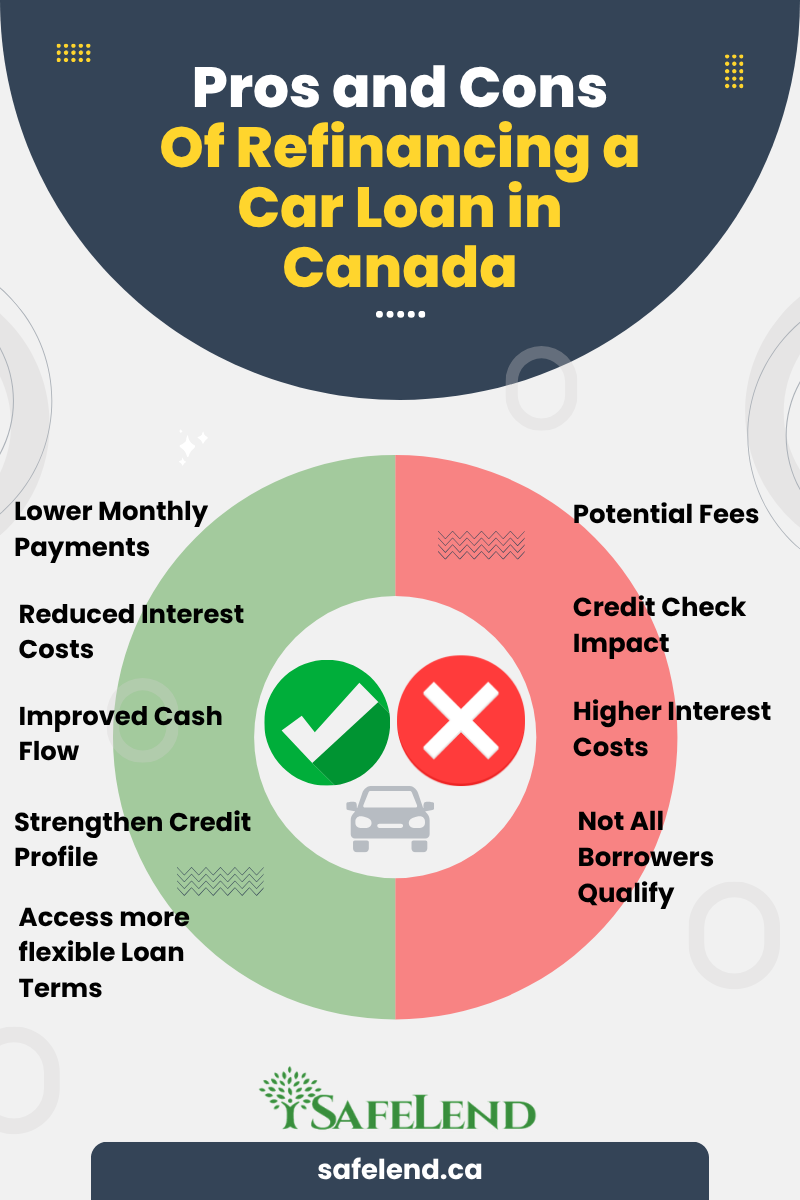
Pros of Car Loan Refinancing
- Lower monthly payments by securing a lower interest rate or extending your loan term
- Reduced interest costs over time if you qualify for better rates
- Improved cash flow, giving you more flexibility in your monthly budget
- Opportunity to strengthen your credit profile with consistent, on time payments
- Access to more flexible loan terms that better align with your current financial situation
These benefits can be especially valuable if you originally financed your vehicle with a high interest rate, have improved your credit, or want to restructure your loan for better affordability.
Cons of Car Loan Refinancing
- Potential fees, including application fees or prepayment penalties on your existing loan
- Credit check impact, which may temporarily affect your credit score
- Higher total interest costs if you extend your loan term to lower monthly payments
- Not all borrowers qualify, especially those with significant negative equity or unstable income
Is Refinancing the Right Choice for You?
Before refinancing, take time to evaluate how it fits into your broader financial strategy. Consider whether your goal is to lower monthly payments, reduce total interest, or improve cash flow in the short term.
Comparing offers from multiple lenders and reviewing the full cost of the loan, not just the monthly payment, can help you make a more informed decision. When used strategically, refinancing can be a valuable tool for improving your financial position and creating a more manageable loan structure.
Refinancing can lower your payments, but extending your loan may increase total interest over time.
Can Refinancing a Car Loan Lower Your Monthly Payments?
Yes, refinancing a car loan in Canada can lower your monthly payments by securing a lower interest rate, extending your loan term, or both.
A lower interest rate reduces the amount of interest charged over time, which can decrease your monthly payment while also lowering your total borrowing cost. Extending your loan term spreads payments over a longer period, making each payment smaller, though this may increase the total interest paid over the life of the loan.
Lower payments are often the main goal, but it is important to balance monthly affordability with total loan cost.
The exact impact depends on your financial profile and the terms of your new loan. Borrowers who have improved their credit score, reduced debt, or originally financed at a higher rate may see the most significant savings.
To find the best outcome, it is important to compare offers from multiple lenders and review both the monthly payment and total loan cost. Using a refinance calculator can help you estimate how different rates and terms affect your payments and overall savings.
Refinancing can also help improve cash flow, making it easier to manage other financial obligations. When used strategically, it can create a more affordable and sustainable loan structure that aligns with your current financial situation.

What Happens to Your Current Auto Loan When You Refinance in Canada?
When you refinance your auto loan in Canada, your new lender pays off your existing loan and replaces it with a new one under updated terms. This new loan may include a lower interest rate, adjusted monthly payments, or a different loan term that better fits your financial situation.
Once the original loan is paid off, your previous agreement is closed, and you begin making payments to your new lender. The transition is typically seamless, with no gap between loans when the process is handled correctly.
In most cases, you will not need to handle the loan payoff yourself, as the new lender manages this process.
One of the main advantages of refinancing is the ability to restructure your loan to better align with your goals. This may include lowering your monthly payments, reducing your interest rate, or adjusting the length of your loan. However, it is important to review any fees, such as prepayment penalties or application costs, that could affect your overall savings.

Comparing offers from multiple lenders can help you secure the most competitive terms. For borrowers with improved credit or more stable financials, refinancing may also open the door to better rates and more flexible payment options.
By understanding how the process works and evaluating the full cost of your new loan, you can make a more informed decision and create a loan structure that supports your long term financial stability.
Can You Refinance a Leased Vehicle in Canada?
In Canada, you cannot refinance a leased vehicle in the same way you would refinance a car you own. Leasing means you are paying to use the vehicle for a set period, not financing ownership.
This is a common point of confusion for many borrowers considering their options.
However, you do have an option at the end of your lease, a lease buyout. This allows you to purchase the vehicle and then refinance it with a new loan that better fits your financial situation.
How Refinancing Works After a Lease Buyout
- You purchase the vehicle at the agreed buyout price
- You apply for a new auto loan to finance that purchase
- Your new lender provides a loan with updated terms, such as a lower interest rate or adjusted payments
What to Consider Before Refinancing a Lease Buyout
- Your credit profile, which impacts your approval and interest rate
- The vehicle’s value, to ensure it aligns with the buyout price
- Your budget, including monthly payments and total loan cost
- Any fees or penalties tied to your lease agreement
Is a Lease Buyout and Refinance Worth It?
Refinancing after a lease buyout can make sense if you want to keep your vehicle and secure more manageable loan terms. It may also help lower your monthly payments, improve cash flow, or provide a more flexible financing structure.
However, it is important to compare your options and ensure the total cost of financing aligns with your long term financial goals. When done strategically, this approach can turn a short term lease into a more stable and affordable ownership path.
Conclusion: Making Car Loan Refinancing Work for You
Car loan refinancing in Canada can be a smart way to lower your monthly car payments, reduce interest charges, and better align your loan with your current financial situation. Whether your goal is to improve cash flow, secure better interest rates, or restructure your financial obligations, auto refinancing gives you the flexibility to adjust as your needs change.

Before moving forward, it is important to understand the refinance process, compare financing options across online lenders and traditional banks, and review how different terms affect your monthly payments and total interest. Reviewing lender requirements and your current credit score and credit history can also help you determine the best path forward.
Platforms like SafeLend Canada make it easier to complete a refinance application and explore multiple lender options in one place, helping you find a solution that fits your credit situation and long term financial goals.
When used strategically, auto refinance is not just about replacing a loan, it is about improving your financial position and creating a more manageable path forward.
Frequently Asked Questions About Refinancing
What is auto loan refinancing?
Car loan refinancing means replacing your current auto loan with a new one that offers better terms, such as a lower interest rate, different loan term, or reduced monthly payments.
How does car loan refinancing work in Canada?
Refinancing works by having a new lender pay off your existing loan and replace it with a new agreement. You then make payments under the new terms, which may include a lower rate or adjusted payment schedule.
Can refinancing a car loan lower your monthly payments?
Yes, refinancing can lower your monthly payments by securing a lower interest rate, extending your loan term, or both. The outcome depends on your financial profile and the terms you qualify for.
When is the best time to refinance a car loan in Canada?
The best time to refinance is when your credit score has improved, interest rates have decreased, or your current loan no longer fits your budget. Many borrowers refinance after building a history of consistent payments.
Does refinancing a car loan affect your credit score?
Refinancing may cause a small temporary dip due to a credit check, but it can improve your credit score over time if it results in more manageable payments and a strong payment history.
Can you refinance a car loan with bad credit in Canada?
Yes, some lenders specialize in refinancing for bad credit borrowers. While interest rates may be higher, refinancing can still help lower payments and provide an opportunity to rebuild your credit.
What do you need to qualify for car loan refinancing?
Lenders typically review your credit score, income, vehicle details, and remaining loan balance. You may also need documents such as proof of income, vehicle registration, and insurance.
What happens to your current car loan when you refinance?
Your new lender pays off your existing loan and replaces it with a new one. Once the original loan is closed, you begin making payments under the updated terms.
Can you refinance a leased vehicle in Canada?
You cannot refinance a leased vehicle directly. However, you can complete a lease buyout and then refinance the vehicle with a new loan.
Is refinancing a car loan worth it in Canada?
Refinancing can be worth it if it lowers your monthly payments, reduces your interest rate, or improves your loan structure. It is important to compare offers and review the total cost of the new loan before deciding.
Important Note: This article and its resources are purely for informational use. They do not reflect the offerings of specific companies or lenders. Our goal is to provide knowledge and insights for better financial decision-making. We recommend conducting in-depth research and seeking professional advice before making any financial decisions. SafeLend Canada, while not a lender, collaborates with various lenders to assist clients in refinancing their auto loans.