


Last Updated: March 2026 (Updated to reflect current Canadian auto refinancing trends and lender requirements.)
Published: October 2024
By: Danielle Burton
Category: Leasing vs. Buying a Car, Auto Refinancing
Deciding between leasing and financing is one of the most important financial decisions you’ll make when getting a vehicle. The option you choose will impact your monthly payments, interest charges, and overall vehicle strategy, whether your goal is to ease payments today or drive it for ten years and maximize resale value.
In simple terms, car leasing means you pay to drive a vehicle for a set time while covering its loss in value. Financing means taking out a loan and making payments over time until you own the car. Each option comes with different tradeoffs depending on your budget, driving habits, and long-term goals.
Lease agreements include limits on kilometres and possible fees for wear and tear or extra usage. You may also need to consider options like a lease payout or even a lease-to-own contract if you decide to keep the vehicle. Financing gives you more flexibility, including the ability to customize your car, but may require full coverage or GAP insurance depending on the lender.
In this guide, you’ll learn how car leasing and auto financing work, how costs compare across the auto market, and how to choose the option that best fits your financial situation in Canada.
What You’ll Learn in This Guide
- 1. What Does Financing a Car Mean?
- 2. What Does Leasing a Car Mean in Canada?
- 3. How Do Financing and Leasing Work in Canada? (Step-by-Step Guide)
- 4. How Do Financing vs Leasing Costs Compare in Canada?
- 5. What are the Pros and Cons of Each Option?
- 6. What Factors Should I Consider When Leasing or Buying a Car?
- 7. When Should You Finance vs Lease a Car in Canada?
- 8. Final Thoughts: Financing vs Leasing a Car in Canada
- 9. Frequently Asked Questions
What Does Financing a Car Mean?
Financing a car in Canada means taking out an auto loan to purchase a vehicle and paying it off over time, typically between 3 and 8 years, until you fully own it.

Instead of paying only for depreciation like leasing, financing requires you to repay the full value of the vehicle, plus interest. This usually results in higher payments, but each one builds equity in the car.
Most financing agreements include a down payment, which can reduce both your monthly payments and the total interest paid over the life of the loan. You will also need to account for taxes, registration, and any applicable fees at the time of purchase.
Your interest rate plays a major role in the total cost of financing and is influenced by factors such as your credit score, income stability, loan term, and current market conditions in Canada. Lower interest rates can significantly reduce the total cost of borrowing. This is especially important if you already have a loan, as and reduce your total borrowing cost.
One key advantage of financing is that there are no mileage restrictions. You can drive as much as you want without penalties, making it a better option for high-mileage drivers or those with long commutes.
As the vehicle owner, you are responsible for maintenance and repairs, especially after the manufacturer’s warranty expires. However, you also have full control over the vehicle, including the ability to customize, modify, or sell it at any time.
Once your loan is fully paid off, you own the car outright. This eliminates monthly payments and gives you an asset you can trade in or sell, helping reduce the cost of your next vehicle.
Key Takeaway: Financing a Car
- Higher monthly payments
- Builds equity over time
- No mileage limits
- Full ownership and control
What Does Leasing a Car Mean in Canada?
Leasing a car in Canada means paying to use a vehicle for a fixed period, usually 2 to 4 years, without owning it at the end of the agreement.
Instead of paying for the full value of the car, your monthly payments are based primarily on depreciation during the lease, plus interest and fees. This is why leasing typically results in lower monthly payments compared to financing.
At the start of a lease, you may be required to pay a down payment, along with applicable taxes and fees. However, upfront costs are often lower than when financing a vehicle purchase.

Most lease agreements include mileage limits, commonly between 16,000 and 24,000 kilometres per year in Canada. If you exceed these limits, additional charges will apply, so it’s important to accurately estimate your driving habits before signing a lease.
Leased vehicles must also be returned in good condition. Excessive wear and tear can result in extra fees at the end of the lease term. Some leases may include maintenance coverage, which can help reduce unexpected costs during the lease period.
One of the main advantages of leasing is the ability to drive a new vehicle every few years with the latest features and technology. At the end of the lease, you can return the car or choose a new lease or purchase the vehicle at its predetermined residual value.
However, leasing does not build equity. You do not own the vehicle, and if you end the lease early, you may be responsible for significant penalties or remaining payments.
Leasing can be a good option if you want lower monthly payments, prefer driving newer vehicles, and do not drive excessively each year. However, it is important to fully understand the terms, limits, and potential fees before committing to a lease agreement.
Key Takeaway: Leasing a Car
- Lower monthly payments
- No ownership or equity
- Mileage limits apply
- Easy to upgrade vehicles
How Do Financing and Leasing Work in Canada? (Step-by-Step Guide)
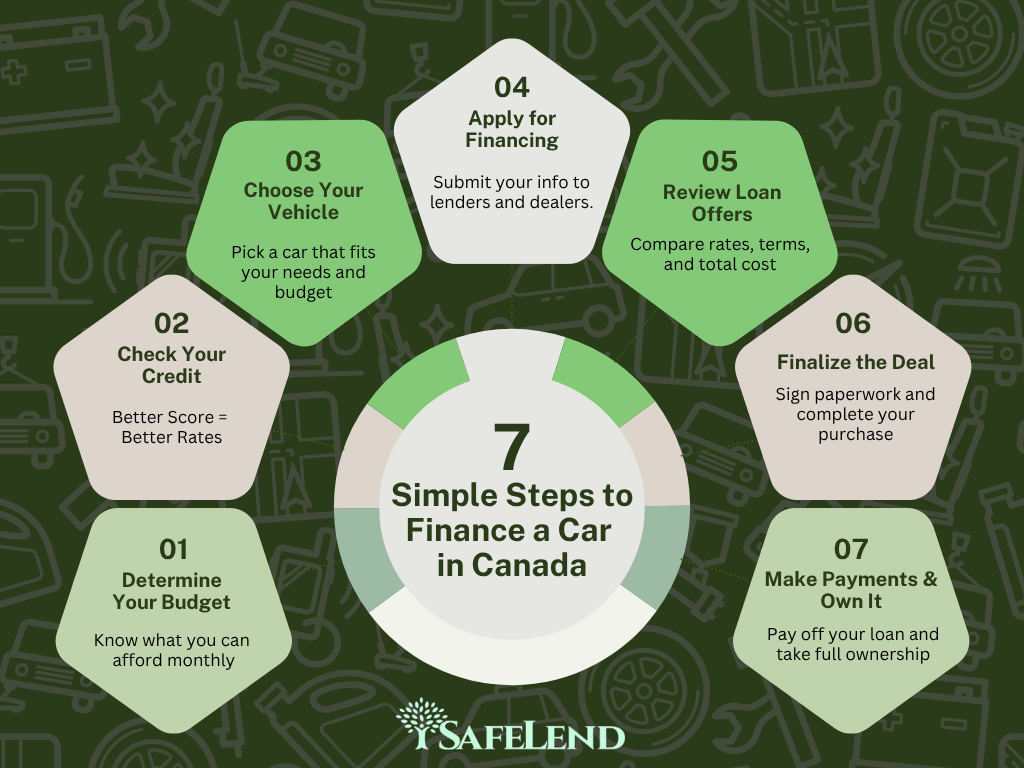
Financing a car in Canada follows a structured step-by-step process, from choosing a vehicle to securing an auto loan and making regular payments until you own the car outright.
Financing Step-by-Step Breakdown
- Determine Your Budget: Start by understanding how much you can afford based on your income, expenses, and existing debt. This helps you set a realistic price range and monthly payment target.
- Check Your Credit Score: Your credit score plays a major role in loan approval and interest rates. In Canada, higher credit scores typically qualify for lower rates, which can significantly reduce your total borrowing cost.
- Choose Your Vehicle:Select a new or used vehicle that fits your budget and lifestyle. Keep in mind that factors like age, mileage, and condition can affect financing options and loan terms.
- Apply for Financing: You can apply through a bank, credit union, dealership, or an online platform that compares multiple lenders. This step involves submitting a loan application with your financial and employment details.
- Get Approved and Review Loan Terms: Once approved, you’ll receive loan offers outlining your interest rate, loan term, and monthly payments. It’s important to compare offers carefully and focus on the total cost of the loan, not just the monthly payment.
- Finalize the Purchase:After selecting a financing option, you complete the paperwork, pay any required down payment, and finalize the purchase. The lender pays the seller, and your loan begins.
- Make Monthly Payments: You’ll make regular payments over the agreed term, typically between 36 and 96 months. Each payment reduces your loan balance and builds equity in the vehicle.
- Own the Vehicle Outright:Once the loan is fully paid off, you own the car completely. At this point, you can keep it, sell it, or trade it in toward your next vehicle.
Understanding how financing works can help you make smarter decisions when choosing a vehicle and loan structure. By comparing lenders, reviewing loan terms carefully, and aligning your payments with your budget, you can reduce your total cost and build long-term value through vehicle ownership.
Leasing Step-by-Step Breakdown
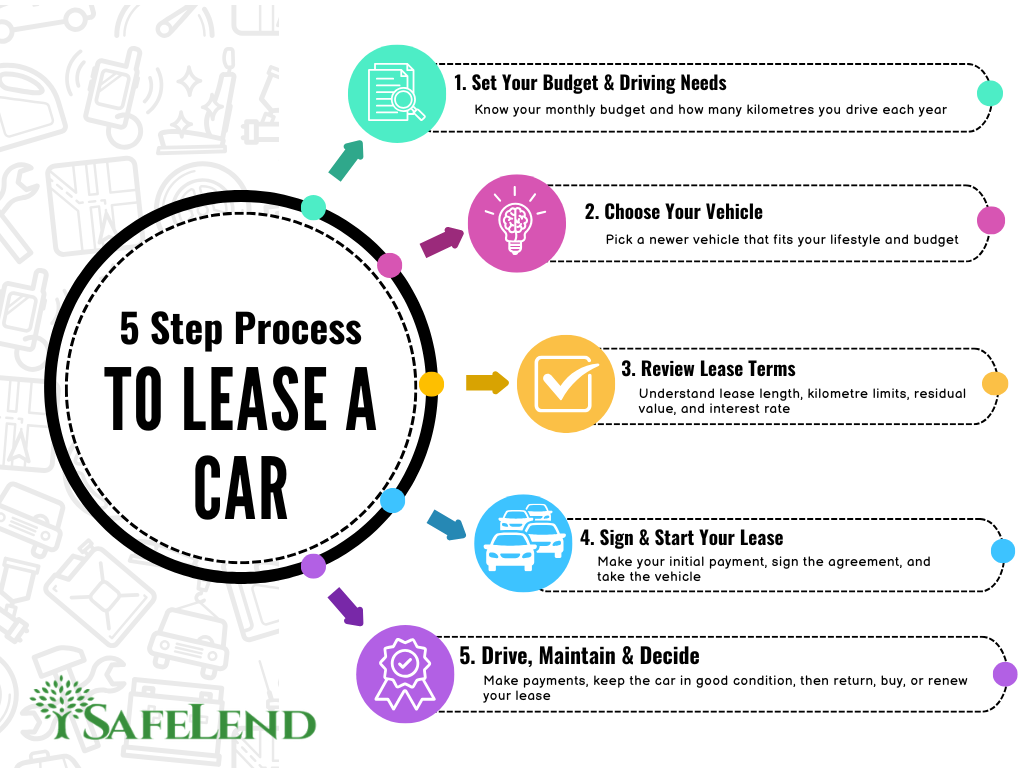
Leasing a car in Canada means paying to use a vehicle for a set term, usually 2 to 4 years, with mileage limits, and returning it at the end without owning it.
-
Determine Your Budget and Driving Needs
Start by assessing your monthly budget and how much you drive each year. This is especially important for leasing, since mileage limits will impact your total cost.
-
Choose a Vehicle
Choose a vehicle that fits your lifestyle and budget. Leasing is often used for newer vehicles, as it allows you to drive updated models with the latest features and technology.
-
Review Lease Terms
Lease agreements include key details such as:
- lease term length, usually 24 to 48 months
- annual mileage limits, often 16,000 to 24,000 km in Canada
- residual value, which is the estimated value of the car at the end of the lease
- money factor or lease interest rate
Understanding these terms is critical before signing.
-
Make Initial Payment
You may be required to pay a down payment, first month’s payment, taxes, and any applicable fees. In many cases, upfront costs are lower than financing a vehicle.
-
Sign the Lease Agreement
Once terms are finalized, you sign the lease contract and take possession of the vehicle. The agreement explains your responsibilities, including how to maintain the vehicle and keep it in good condition.
-
Make Monthly Lease Payments
You’ll make fixed monthly payments throughout the lease term. These payments are based primarily on the vehicle’s depreciation, plus interest and fees.
-
Maintain the Vehicle
You are responsible for keeping the vehicle in good condition. Excess wear and tear, or damage beyond normal use, may result in additional charges at the end of the lease.
-
Return, Buy, or Renew the Lease
At the end of the lease, you typically have three options:
- return the vehicle
- purchase the car at its residual value
- lease a new vehicle
Leasing can be a flexible option if you prefer lower monthly payments and enjoy driving newer vehicles every few years. However, it’s important to understand the contract terms, mileage limits, and potential fees to avoid unexpected costs.
How Do Financing vs Leasing Costs Compare in Canada?
Leasing usually means lower monthly payments but no ownership, while financing has higher payments but lets you build equity and can cost less over time.
| Cost Factor | Leasing a Car | Financing a Car |
|---|---|---|
| Monthly Payments | Lower, based on depreciation | Higher, based on full vehicle cost |
| Upfront Costs | Lower, smaller down payment | Higher, includes taxes on full value |
| Interest / Rates | Lower (money factor) | Higher but builds equity |
| Mileage Limits | Yes, penalties if exceeded | No restrictions |
| Maintenance Costs | Often lower (under warranty) | Higher over time |
| Ownership | No ownership | Full ownership after loan |
| Long-Term Cost | Higher over time | Lower if vehicle is kept |
| Flexibility | Easy to upgrade vehicles | Keep, sell, or trade anytime |
Monthly Payments: Leasing costs less per month because you are only covering depreciation. Financing costs more per month since you are paying the full value plus interest.
Upfront Costs: Leasing usually requires less money upfront, often limited to a smaller down payment, first month’s payment, and fees. Financing generally requires a larger down payment and full taxes on the purchase price.
Long-Term Costs: Leasing can become more expensive over time if you continue leasing vehicles, since you never eliminate monthly payments. Financing is often more cost-effective long term because once the loan is paid off, you no longer have monthly payments.
Mileage and Usage: Leasing includes mileage limits, typically 16,000 to 24,000 km per year in Canada. Exceeding these limits results in penalties. Financing allows unlimited driving with no additional fees.
Maintenance and Repairs: Leased vehicles are often covered under warranty, reducing repair costs. With financing, you are responsible for maintenance, especially after the warranty expires.
Ownership and Equity: Leasing does not build equity, you return the vehicle at the end of the term. Financing builds equity with each payment, and once the loan is paid off, you own the vehicle outright.
In general, leasing is better for lower short-term costs and flexibility, while financing is better for long-term value and ownership. The right choice depends on your budget, driving habits, and how long you plan to keep your vehicle. If your goal is to lower your current payments, reviewing refinancing options can give you a clearer picture of what you could save based on your current loan.
What Are the Pros and Cons of Financing vs Leasing a Car in Canada?
Leasing offers lower monthly payments and flexibility, while financing gives you ownership, equity, and long-term value. Each option comes with tradeoffs based on your financial goals and driving habits.
Pros of Leasing a Car
- Lower monthly payments compared to financing
- Ability to drive a new car every few years
- Often covered under warranty, reducing repair costs
- Lower upfront costs in many cases
- Easier to upgrade to newer models
Cons of Leasing a Car
- No ownership or equity in the vehicle
- Mileage limits, typically 16,000 to 24,000 km per year
- Potential penalties for excess wear and tear
- Ongoing monthly payments if you continue leasing
- Early termination fees can be expensive
Pros of Financing a Car
- Full ownership once the loan is paid off
- Builds equity with each payment
- No mileage restrictions
- Freedom to customize or modify the vehicle
- No monthly payments after the loan term ends
Cons of Financing a Car
- Higher payments compared to leasing
- Higher upfront costs, including taxes and down payment
- Responsible for maintenance and repairs over time
- Vehicle depreciation affects resale value
- Longer financial commitment
Decision Summary
Leasing May Be Better If You:
- want lower monthly payments
- prefer driving newer vehicles frequently
- do not drive long distances annually
- want predictable short-term costs
Financing May Be Better If You:
- want to own your vehicle long term
- drive a lot and need flexibility
- want to build equity
- prefer long-term savings over short-term affordability
What Factors Should I Consider When Leasing or Buying a Car?
Your Monthly Budget
Your budget is one of the most important factors.
- Leasing offers lower monthly payments, which can improve short-term cash flow
- Financing has higher payments but leads to ownership and long-term value
If keeping payments low is your priority, leasing may be the better option. If you can afford higher payments and want to eliminate them over time, financing may be more beneficial.
Your Driving Habits
How much you drive each year matters.
- Leasing includes mileage limits, typically 16,000 to 24,000 km per year
- Financing allows unlimited driving with no penalties
If you have a long commute or drive frequently, financing is usually the better choice.
How Long You Plan to Keep the Vehicle
Your timeline plays a big role in the decision.
- Leasing is ideal for short-term use and frequent upgrades
- Financing is better if you plan to keep the vehicle for many years
If you like changing vehicles every few years, leasing fits that lifestyle. If you prefer long-term stability, financing is the better option.
Maintenance and Repair Tolerance
Consider how comfortable you are with maintenance costs.
- Leased vehicles are often under warranty, reducing repair risks
- Financed vehicles require you to cover maintenance over time
If you want predictable costs, leasing may be more appealing. If you are comfortable managing repairs, financing offers more control.
Ownership vs Flexibility
Think about whether ownership matters to you.
- Leasing provides flexibility but no ownership
- Financing builds equity and gives you full control of the vehicle
If owning your vehicle is important, financing is the clear choice.
Long-Term Financial Goals
Your long-term financial goals should guide your decision.
- Leasing prioritizes lower short-term costs
- Financing focuses on long-term savings and asset ownership
If your goal is to reduce expenses now, leasing may help. If your goal is to build value and eliminate payments over time, financing is typically the better option.
Choosing between leasing and financing comes down to how you balance short-term affordability with long-term value. By aligning your decision with your budget, lifestyle, and financial goals, you can select the option that best supports your overall financial plan.

When Should You Finance vs Lease a Car in Canada?
You should lease a car if you want lower payments and prefer driving newer vehicles, while financing is better if you want to own your car, build equity, and save money over the long term.
When Financing Makes More Sense
You should consider financing if you:
- want to own your vehicle long term
- drive frequently or have a long commute
- want to build equity with each payment
- prefer long-term savings over time
- want the freedom to keep, sell, or modify your vehicle
When Leasing Makes More Sense
You should consider leasing if you:
- want lower monthly payments
- like driving a new vehicle every few years
- do not exceed typical mileage limits (16,000 to 24,000 km per year)
- want lower upfront costs
- prefer predictable, short-term expenses
Quick Decision Snapshot
Lease if you prioritize lower monthly payments and flexibility. Finance if you prioritize ownership, equity, and long-term value.
Final Thoughts: Financing vs Leasing a Car in Canada
Choosing between car leasing and auto financing in Canada comes down to your budget, driving habits, and long-term plans.
Car leasing can be a strong option if you want to ease payments, reduce upfront costs, and drive a new vehicle every few years. It works best for those who are comfortable with mileage restrictions, kilometer allowance limits, and potential costs like excessive wear and tear or wear and tear charges outlined in a leasing contract. It can also appeal to drivers who are focused on short-term flexibility within the current auto market.
Auto financing, on the other hand, is better suited for drivers who want full ownership, the ability to build equity, and maximize resale value over time. While payments are usually higher, financing lets you avoid kilometer limits, customize your car, and keep it for many years. Tools like an auto loan payment calculator can help you better understand your long-term costs based on market value and depreciation rate.
The key is to evaluate how each option fits your budget and long-term plans. Consider your budget, how much you drive, and how long you plan to keep your vehicle before making a decision.
By understanding the true costs and tradeoffs, you can confidently choose the option that supports both your lifestyle and your long-term financial future.
If you’re unsure which option is right for your situation, reviewing personalized refinancing options can help you better understand your potential savings and next steps.
Frequently Asked Questions About Financing vs. Leasing
What is the main difference between leasing and financing a car?
Leasing means you pay to use a car for a fixed period and return it at the end, while financing means you take out a loan to buy the car and own it once it is fully paid off.
Are monthly payments higher for leasing or financing?
Payments are typically lower with leasing because you are only paying for depreciation. Financing payments are higher since you are paying off the full value of the car plus interest.
Can I drive as much as I want with a leased car?
No, leased vehicles come with mileage limits, usually between 16,000 and 24,000 kilometres per year in Canada. Exceeding these limits can result in additional fees.
What happens at the end of a car lease?
At the end of a lease, you can return the vehicle, purchase it at its residual value, or lease a new vehicle. The best option depends on your financial situation and future plans.
Do I build equity with a leased car?
No, leasing does not build equity because you do not own the vehicle. Financing builds equity over time as you pay down the loan.
Is it more cost-effective to lease or finance a car?
Leasing is usually cheaper in the short term with lower payments, while financing is typically cheaper in the long term because you eventually own the car.
Can I customize a leased car?
No, leased vehicles generally cannot be customized. Any modifications may need to be reversed before returning the vehicle, and additional fees may apply.
What are the advantages of financing a car?
Financing allows you to build equity, avoid mileage limits, customize your vehicle, and eliminate monthly payments once the loan is paid off.
What are the benefits of leasing a car?
Leasing offers lower monthly payments, lower upfront costs, access to newer vehicles, and often includes warranty coverage that reduces repair costs.
How do I decide whether to lease or finance a car?
Consider your budget, driving habits, and long-term goals. Leasing is better for flexibility and lower payments, while financing is better for ownership and long-term savings.
Does leasing or financing affect your credit score?
Both leasing and financing can impact your credit score. On-time payments help build credit, while missed payments can negatively affect it.
Important Note: This article and its resources are purely for informational use. They do not reflect the offerings of specific companies or lenders. Our goal is to provide knowledge and insights for better financial decision-making. We recommend conducting in-depth research and seeking professional advice before making any financial decisions. SafeLend Canada, while not a lender, collaborates with various lenders to assist clients in refinancing their auto loans.