


May 2026
Published: May 2026 (Updated to reflect current Canadian auto refinancing trends and lender requirements.)
By: Danielle Burton
Category: Co-Signer
Getting approved for a car loan in Canada isn’t always simple. If you have limited credit history, a low credit score, or past financial challenges, lenders may see the main borrower as higher risk and question overall loan eligibility. That’s where a co-signer in the auto loan process can make a significant difference, especially when trying to secure better terms or reduce the need for a large down payment.
A co-signer is someone who agrees to take equal legal responsibility for your car loan. While they don’t own the vehicle, they are required to repay the loan if the primary borrower cannot. In situations where payments are missed or the loan goes into default, both the borrower and co-signer can be impacted, including potential involvement from a collection agency. For many Canadians, including those applying with a spouse or common-law partner, adding a co-signer can improve approval chances, unlock better interest rates, and create more flexible financing options.
In this guide, we break down what a co-signer is, how co-signing a car loan works, why lenders require a co-signer, and how it affects both the borrower and the co-signer’s credit score and financial future.
In This Guide:
- 1. What is a co-signer on a car loan in the auto loan process?
- 2. Why do lenders require a co-signer?
- 3. What responsibilities does a co-signer have?
- 4. Can a co-signer help you get approved?
- 5. Pros and cons of having a co-signer on a car loan
- 6. How co-signing a car loan affects your credit score
- 7. Who should consider using a co-signer (and who shouldn’t) for auto financing
- 8. Final thoughts: Understanding the role of a co-signer in auto financing
- 9. Frequently asked questions about co-singers and car loans
1. What Is a Co-Signer in the Auto Loan Process?
A co-signer in the auto loan process is someone who agrees to take equal legal responsibility for a car loan alongside the primary borrower. If the borrower misses payments or defaults, the co-signer is required to repay the remaining loan balance, including interest, fees, and penalties.
Unlike a co-borrower, a co-signer does not typically have ownership of the vehicle or the right to drive it. Their role is to strengthen the loan application by providing a stronger credit score, stable income, or a more reliable financial profile to reassure the lender and reduce overall risk.
Quick Answer: What Is a Co-Signer on a Car Loan?
A co-signer is someone who agrees to repay a car loan if the primary borrower cannot. They do not own the vehicle but are fully responsible for the debt if payments are missed.
Why Do You Need a Co-Signer for a Car Loan?
Lenders may require a co-signer when the primary applicant presents a higher risk profile, including:
- Low or limited credit history
- Past bankruptcy or missed payments
- High debt-to-income ratio (DTI)
- Limited income or unstable employment
- Little to no previous auto loan experience
A co-signer helps reduce lender risk by adding a second financially responsible party. This increases the likelihood of approval and can lead to better loan terms, including lower interest rates and more flexible repayment options.
What Most People Don’t Know About Co-Signers
Beyond basic definitions, there are several important factors many borrowers and co-signers overlook:
-
It impacts both credit reports
The auto loan appears on both credit profiles. Missed payments damage both credit scores, while consistent payments benefit both parties. -
It affects future borrowing power
The co-signed loan counts toward the co-signer’s total debt, which can impact their ability to qualify for a mortgage, credit card, or another car loan. -
Removing a co-signer is not simple
In most cases, the borrower must refinance the car loan in their own name, pay off the loan, or sell the vehicle to release the co-signer.
2. Why Do Lenders Require a Co-Signer?
Lenders require a co-signer to reduce the risk of approving a car loan when a borrower does not fully meet lending criteria on their own. If there is uncertainty around repayment, a co-signer provides an additional layer of financial security by sharing full legal responsibility for the loan.
From a lender’s perspective, a co-signer strengthens the overall loan application and improves the likelihood that the loan will be repaid in full and on time.
How Lenders Evaluate Risk on a Car Loan Application
Before approving a car loan, lenders assess several key factors to determine whether a borrower can reliably make payments:
- Credit score and credit history
- Income stability and employment history
- Debt-to-income ratio (DTI)
- Loan amount compared to income
- Overall credit behaviour and repayment patterns
If one or more of these areas fall below acceptable thresholds, the application may be considered higher risk. This is where a co-signer becomes important.
When a Co-Signer Becomes Necessary
A lender is more likely to require a co-signer when the application shows:
- Low credit score or no established credit history
- Previous missed payments, collections, or bankruptcy
- Income that does not fully support the loan amount
- High existing debt relative to income
- Limited experience managing installment loans
In these situations, the lender may not decline the application outright, but instead request a co-signer to strengthen it.
What Lenders Look for in a Co-Signer
A co-signer is evaluated just as carefully as the primary borrower. Lenders typically look for:
- Strong and consistent income
- Stable employment history
- Low overall debt obligations
- Proven track record of on-time payments
- Established credit history across multiple account types
A qualified co-signer helps offset weaknesses in the borrower’s profile and can significantly improve the structure of the loan.
Less Obvious Reasons Lenders Ask for a Co-Signer
Beyond the common factors, there are additional scenarios where a co-signer may be requested:
- Loan amount is high relative to income: Even with fair credit, a larger loan may require added support
- Recent credit activity: Multiple new accounts or inquiries can signal increased risk
- Limited credit mix: Borrowers with only credit cards and no loan history may be seen as unproven
These situations don’t always result in a decline, but they can trigger a request for a co-signer to stabilize the application.
A Co-Signer Can Improve More Than Just Approval
A co-signer is not only used to get approved for a car loan, it can also improve the overall financing outcome. With a qualified co-signer, borrowers may receive:
- Lower interest rates
- Higher approved loan amounts
- More flexible repayment terms
- Reduced upfront requirements
This is why some borrowers choose to use a co-signer even if they qualify on their own, as it can lead to meaningful long-term savings.
3. What Responsibilities Does a Co-Signer Have?

When you agree to co-sign a car loan, you are entering a legally binding financial agreement, not just supporting someone’s application. A co-signer shares full responsibility for the loan from day one, even without owning or driving the vehicle.
In Canada, co-signing a car loan means you are legally responsible for the debt for the full term of the loan. The auto loan is reported on both credit profiles immediately, and lenders treat the co-signer as equally accountable for repayment, regardless of who is making the payments.
The Core Responsibilities of a Co-Signer
- Full repayment responsibility: If the borrower misses payments or defaults, the co-signer must cover the full loan balance, including interest, late fees, and any collection or repossession costs
- Shared credit exposure: The loan appears on both credit reports, and all payment activity, positive or negative, impacts both credit scores
- Debt-to-income (DTI) impact: The loan is included in the co-signer’s total debt, which can affect their ability to qualify for other financing such as a mortgage, personal loan, or another car loan
Hidden Responsibilities Many Co-Signers Overlook
Beyond the obvious risks, there are additional factors that can catch co-signers off guard:
- No guaranteed payment notifications: Lenders do not always notify co-signers of missed or late payments, meaning credit damage can happen before they are aware
- Exposure to collections and legal action: If the loan goes into default, the lender can pursue the co-signer directly for repayment through collections or legal enforcement
- No easy way to exit the loan: A co-signer typically remains on the loan until it is fully repaid or refinanced, which may take several years
Common Misconception: “It Doesn’t Affect Me if Payments Are On Time”
Even if every payment is made on time, the co-signed loan still affects the co-signer’s financial profile. It can impact ability to qualify for future loans, overall debt load, and financial
flexibility in emergencies.
How to Manage Co-Signer Responsibilities
If you choose to co-sign a car loan, taking a proactive approach can help reduce risk:
- Maintain regular communication: Stay informed about payment activity and the borrower’s financial situation
- Set up account access or alerts: Where possible, ensure visibility into the loan to monitor payments
- Have a contingency plan: Be prepared to step in financially if the borrower cannot make payments
4. Can a Co-Signer Help You Get Approved?

Yes, a co-signer can significantly improve your chances of getting approved for a car loan, especially if you have bad credit, no credit history, or inconsistent income.
A co-signer strengthens your application by adding a second, more established credit profile. This reduces the lender’s risk and increases the likelihood of approval.
Quick Answer: Can a Co-Signer Help You Get Approved?
A co-signer can help you get approved for a car loan by improving your overall credit profile and reducing lender risk. They agree to repay the loan if you cannot, which makes lenders more
comfortable approving the application.
How a Co-Signer Improves Loan Approval
A co-signer improves approval odds by strengthening the key factors lenders evaluate:
- Stronger credit profile: A higher credit score and positive payment history increase overall application strength
- Improved income support: Additional income can help meet lender requirements for affordability
- Lower perceived risk: A second responsible party reduces the chance of loss for the lender
- Access to better lending tiers: You may qualify with prime lenders instead of subprime options
Who Benefits Most from a Co-Signer?
A co-signer is most helpful for borrowers who do not yet meet standard lending criteria on their own:
- First-time car buyers with no credit history
- Newcomers to Canada building a credit profile
- Young adults or students with limited income
- Borrowers rebuilding credit after past financial issues
- Self-employed individuals with variable income
A Co-Signer Can Also Improve Your Loan Terms
Getting approved is only part of the benefit. A qualified co-signer can also improve the structure of your car loan.
With a co-signer, you may receive:
- Lower interest rates
- Higher approved loan amounts
- More flexible repayment terms
- Reduced upfront requirements
Even if you qualify on your own, adding a co-signer can lead to meaningful savings over the life of the loan.
What Most Borrowers Don’t Realize
There are additional advantages and limitations that are often overlooked:
- Greater lender flexibility: You may gain access to better lenders with fewer restrictions
- Offsets weaker areas in your profile: A co-signer can balance factors like short employment history or high credit usage
- Co-signer removal requires refinancing: To remove a co-signer later, you typically need to refinance the loan in your own name
A Co-Signer Helps, But You Still Need to Qualify
A co-signer strengthens your application, but it does not replace your own eligibility.
You will still need to demonstrate:
- Proof of income
- Stable employment or consistent earnings
- Ability to make monthly payments
The co-signer supports your application, but lenders still evaluate your ability to repay the loan.
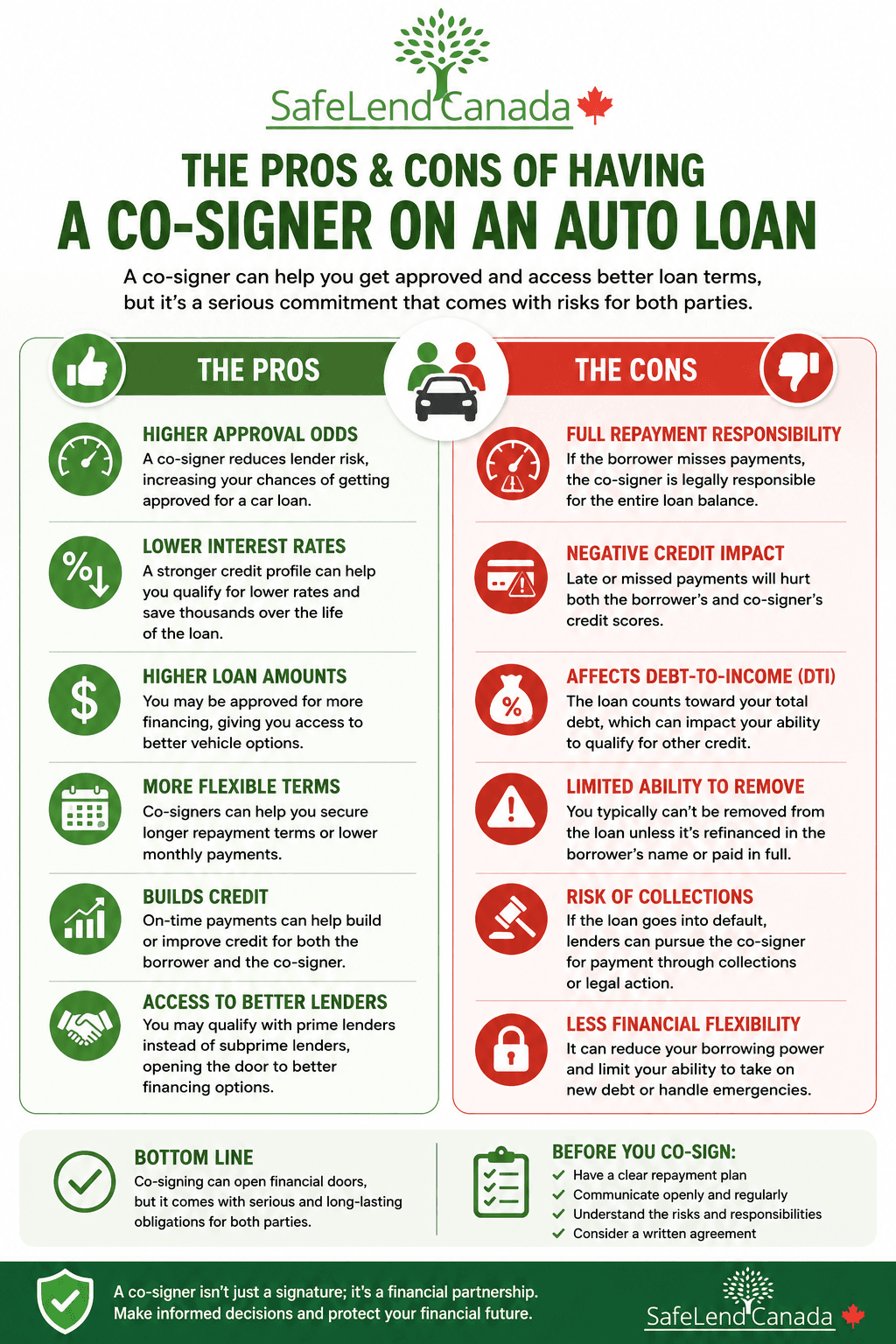
5. Pros and Cons of Having a Co-Signer on a Car Loan
Adding a co-signer to a car loan can improve your chances of approval and help you access better financing options. However, co-signing is a shared financial commitment that carries both benefits and risks for the borrower and the co-signer.
Understanding both sides is essential before moving forward.
The Benefits of Having a Co-Signer
A co-signer can strengthen your loan application and improve your overall financing outcome.
- Higher approval chances: A co-signer increases your likelihood of getting approved for a car loan, especially with bad credit or no credit history
- Lower interest rates: A stronger credit profile can help you qualify for better rates and reduce the total cost of borrowing
- Access to better lenders: You may qualify with prime lenders instead of subprime lenders, leading to more competitive loan options
- Higher loan amounts: A co-signer can help you qualify for a larger loan, giving you more flexibility when choosing a vehicle
- Opportunity to build credit: Consistent, on-time payments can help improve your credit history over time
The Risks of Having a Co-Signer
- Full financial responsibility: Co-signer is legally responsible if borrower defaults
- Negative impact on both credit scores: Late or missed payments affect both profiles
- Increased debt-to-income ratio (DTI): Limits ability to qualify for other financing
- Limited ability to remove the co-signer: Usually requires refinancing or paying off the loan
- Reduced financial flexibility: Taking on additional debt impacts future borrowing power
Quick Comparison: Is a Co-Signer Worth It?
A co-signer may be worth it if:
- You are unable to get approved on your own
- You want to secure a lower interest rate
- You have a clear and reliable repayment plan
A co-signer may not be necessary if:
- You already qualify for a car loan with strong terms
- You have good credit and stable income
- The risks outweigh the potential savings
Bottom Line: A Shared Financial Commitment
Co-signing is not just a formality, it is a long-term financial obligation that affects both parties.
For borrowers, it can open the door to better approval odds and lower costs. For co-signers, it is a commitment that can impact credit, debt levels, and future borrowing ability.
Before moving forward, both parties should:
- Agree on a clear repayment plan
- Maintain open communication
- Understand the full financial risks
- Consider documenting expectations in writing
6. How Co-Signing a Car Loan Affects Your Credit Score
Co-signing a car loan has a direct and ongoing . Even if you are not making the payments, the loan appears on your credit report and is treated as your financial responsibility. Every payment made on the loan, whether on time or late, affects both the borrower’s and the co-signer’s credit profiles.
Quick Answer: Does Co-Signing Affect Your Credit Score?
Yes. A co-signed car loan appears on your credit report and impacts your credit score. On-time payments can help build credit, while missed payments can significantly lower your score.
1. The Loan Appears on Your Credit Report
As soon as you co-sign, the auto loan is reported to the credit bureaus under both names.
This means:
- The full loan balance is added to your total debt
- Payment activity is recorded on your credit report
- The account is included in your debt-to-income (DTI) ratio
Even if you never make a payment, the loan is considered your obligation from a credit standpoint.
2. On-Time Payments Can Help Build Credit
If the borrower consistently makes payments on time, there can be a positive impact on your credit profile:
- Strengthens your payment history, the most important credit scoring factor
- May lead to gradual improvements in your credit score
- Contributes to a more balanced credit mix if you lack installment loans
This is one of the few benefits of co-signing, but it depends entirely on consistent repayment.
3. Missed or Late Payments Can Hurt Your Credit Quickly
The risk to your credit is immediate if payments are missed.
If the borrower is late or defaults:
- Negative marks are added to your credit report
- Your credit score can drop significantly
- Delinquencies can remain on your report for up to 7 years
In many cases, co-signers are not notified of missed payments right away, which increases the risk of unexpected damage.
4. It Can Affect Your Ability to Qualify for Other Loans
Even with perfect payment history, a co-signed car loan still impacts your borrowing profile.
It can:
- Increase your debt-to-income ratio
- Reduce your chances of qualifying for a mortgage or new loan
- Limit your available credit in the eyes of lenders
This is especially important if you plan to apply for financing in the near future.
5. Your Credit Is Tied to the Loan for the Full Term
Most car loans last between 4 and 7 years. During that time:
- The loan remains on your credit report
- Your credit exposure continues for the full term
- You remain financially connected unless the loan is refinanced or paid off
There is no automatic removal of a co-signer once payments are established.
How to Protect Your Credit as a Co-Signer
If you decide to co-sign a car loan, taking proactive steps can help reduce risk:
- Monitor the loan regularly through account access or statements
- Set up alerts for payment activity if available
- Maintain open communication with the borrower
- Have a financial backup plan in case payments are missed
- Avoid co-signing if you plan to apply for major credit soon
Key Takeaway: Co-Signing Impacts Your Credit Long-Term
Co-signing a car loan can help build credit when managed properly, but it also carries real risk. Because the loan is reported on your credit file, your financial profile is directly tied to how the loan is handled over time.
Before agreeing to co-sign, it’s important to understand that you are taking on shared responsibility for both the debt and its impact on your credit score.

7. Who Should Consider Using a Co-Signer (and Who Shouldn’t) for Auto Financing?
A co-signer can be a powerful tool, but it’s not necessary for everyone. The right decision depends on your credit profile, income stability, and overall financial position.
Who Benefits Most from a Co-Signer?
- First-Time Car Buyers:
If you have never financed a vehicle or built a credit history, lenders may view your application as unproven.
A co-signer can:
- Help establish trust with lenders
- Improve your chances of approval
- Allow you to begin building credit through an installment loan
- Borrowers with Limited or No Credit History:
A thin or non-existent credit file makes it difficult for lenders to assess risk.
This commonly applies to:
- Students
- Newcomers to Canada
- Individuals who have not used credit before
A co-signer provides a stronger credit profile to support the application.
- Borrowers Rebuilding Their Credit:
If you’ve experienced past financial challenges such as missed payments, collections, or bankruptcy, your credit score may not reflect your current financial habits.
A co-signer can:
- Help you qualify for better loan terms
- Provide access to more competitive lenders
- Support your efforts to rebuild credit with consistent payments
- Self-Employed or Variable-Income Earners:
Lenders often prefer consistent, verifiable income.
If your income fluctuates or is harder to document, a co-signer with stable employment can strengthen your application and improve approval confidence.
- Borrowers with Limited Employment History:
Even with fair credit, a short employment history can raise concerns for lenders.
A co-signer can help meet underwriting requirements by adding stability and financial consistency to the application.
- Borrowers Looking to Improve Loan Terms:
A co-signer is not only for approval, it can also be used strategically to improve your loan.
With a strong co-signer, you may be able to:
- Secure a lower interest rate
- Increase your approved loan amount
- Access better financing options
- Reduce upfront costs
When You May Not Need a Co-Signer
A co-signer may not be necessary if your financial profile already meets lender requirements.
You likely do not need a co-signer if you:
- Have good to excellent credit
- Maintain stable income and employment
- Have a low debt-to-income ratio
- Qualify for competitive rates on your own
In these cases, adding a co-signer may not provide meaningful benefits and could add unnecessary complexity.
Key Takeaway: A Co-Signer Is a Strategic, Not Default, Option
A co-signer is not a shortcut to approval, it is a strategic financial decision. It can help overcome specific challenges or improve loan terms, but it also introduces shared risk and responsibility.
Before moving forward, consider whether the benefits outweigh the risks for both parties, and ensure there is a clear plan in place for repayment.
8. Final Thoughts: Understanding the Role of a Co-Signer in Auto Financing
Co-signing a car loan is more than helping someone get approved, it is a long-term financial commitment that directly impacts credit, borrowing power, and overall financial stability. Both the borrower and co-signer share responsibility for the loan, meaning the main borrower’s actions can directly affect the co-signer’s financial position.

For borrowers, a co-signer can improve approval chances, reduce the need for a large down payment, unlock lower interest rates, and provide an opportunity to build or rebuild credit. For co-signers, it is a way to support someone’s financial goals, whether that’s a family member, spouse, or common-law partner, but it also introduces real exposure to debt and credit risk.
If payments are missed or the loan goes into default, both parties may face serious consequences, including damage to their credit and potential escalation to a collection agency. This is why co-signing should always be approached with a clear understanding of the responsibilities involved.
Co-signing is not limited to auto loans. The same principles apply to other financial agreements, including mortgages and lease arrangements. In every case, the co-signer shares legal responsibility for repayment, regardless of who is making the payments.
Before entering into a co-signing agreement, both parties should:
- Agree on a clear repayment plan
- Understand how the loan will impact both credit profiles
- Maintain open and ongoing communication
- Have a plan for refinancing or ending the agreement in the future
A co-signer can make car loan approval and better financing possible, but it should always be treated as a strategic financial decision, not a simple favour. When used responsibly, it can help build credit and open financial opportunities. When mismanaged, it can lead to loan default, long-term financial strain, and reduced borrowing power for both parties.
9. Frequently Asked Questions About Co-Signers and Car Loans
1. What is a co-signer and how does it work for an auto loan?
A co-signer is a responsible person who agrees to share full financial responsibility for a car loan with the primary borrower. While the co-signer does not own the vehicle, they are legally required to repay the loan if the main borrower misses payments or goes into loan default. A co-signer’s stronger credit profile can improve credit approval and help secure better loan terms.
2. Who can be a co-signer?
A co-signer can be anyone who meets lender eligibility requirements, including a family member, spouse, or trusted individual. Lenders typically look for someone with a strong credit score, stable income, low debt levels, and a proven history of on-time payments.
3. Does co-signing affect my credit score?
Yes. A co-signed car loan appears on both the borrower’s and co-signer’s credit reports. Payment activity impacts both parties, on-time payments can help build credit, while missed payments or loan default can significantly lower credit scores.
4. Can a co-signer help me get approved for a car loan?
Yes. A co-signer can improve your chances of credit approval by strengthening the overall loan application. Lenders are more likely to approve a car loan when a second responsible person supports the primary borrower, especially if the borrower does not fully meet income requirements or credit criteria.
5. Can a co-signer help lower my interest rate?
In many cases, yes. A qualified co-signer with strong credit can help the borrower access lower interest rates, better loan terms, and more flexible financing options. This can reduce the total cost of the car loan over time.
6. What are the risks of being a co-signer?
Co-signing carries significant financial risk. If the primary borrower misses payments or defaults, the co-signer is fully responsible for repaying the loan. It can also impact the co-signer’s credit score, increase their debt-to-income ratio, and limit their ability to qualify for future financing.
7. What’s the difference between a co-signer and a co-borrower?
A co-borrower shares ownership of the vehicle and is equally responsible for the loan. A co-signer, on the other hand, supports the loan for credit approval purposes but does not typically have ownership rights. Both are legally responsible for repayment.
8. Can a co-signer be removed from a car loan?
Not easily. To remove a co-signer, the primary borrower usually needs to refinance the car loan in their own name or fully repay the loan. Until then, the co-signer remains legally responsible for the debt.
9. Can co-signing affect my ability to get a mortgage or other loan?
Yes. A co-signed loan counts as part of your total debt, which can impact your eligibility requirements for other financing. Even if the borrower is making payments, lenders may view the loan as your obligation when assessing mortgage or loan applications.
10. Is co-signing a good idea for a first-time borrower?
It can be. A co-signer can help a first-time borrower get approved for a car loan and start building credit. However, both parties should understand the risks, have a clear repayment plan, and ensure the loan fits within a realistic budget.
11. What should I consider before co-signing for someone?
Before co-signing, consider the borrower’s ability to make consistent payments, your own financial goals, and the potential impact on your credit. You should also review the loan terms together, understand the income requirements, and have a plan in place in case the borrower cannot pay.

Important Note: This article and its resources are purely for informational use. They do not reflect the offerings of specific companies or lenders. Our goal is to provide knowledge and insights for better financial decision-making. We recommend conducting in-depth research and seeking professional advice before making any financial decisions. SafeLend Canada, while not a lender, collaborates with various lenders to assist clients in refinancing their auto loans.